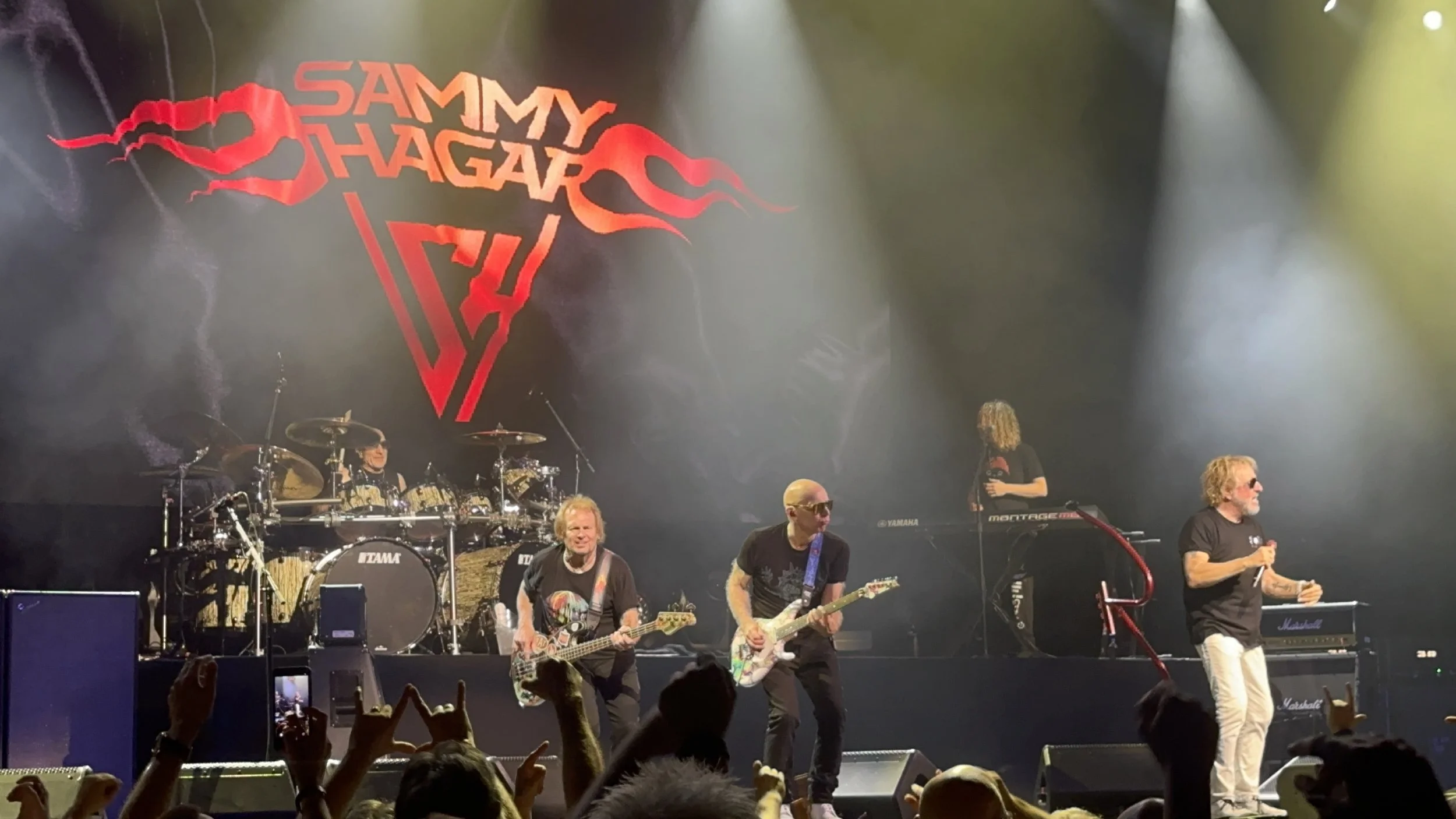
Sammy Hagar – British Airways ARC, London – 12th July 2026
Sammy Hagar – British Airways ARC, London – 12 July 2026
The Best of All Worlds – Three Nights of Rock ’n’ Roll History
Review by Robert Corich
Thirty years is a hell of a long time to wait.
That was the thought that kept returning as Sammy Hagar took the stage at London’s British Airways ARC for the third and final night of his extraordinary three-show residency. Thirty years since the Red Rocker last brought his solo show to these shores, and yet here he was in 2026 looking less like a man finally making a long-overdue return and more like somebody who had simply been waiting for the right moment to come back and have some fun.
And fun was most definitely on the agenda.
The evening had already begun promisingly with Jayler opening proceedings. The young British four-piece delivered a confident blast of 1970s-inspired hard rock, their Led Zeppelin influences worn sufficiently proudly to raise a knowing smile. There is clearly considerably more to this band than mere imitation, however, and after watching them give it everything on this stage, I suspect Greta Van Fleet might want to keep one eye on the rear-view mirror.
It was a suitably appropriate way to begin an evening that would ultimately take us through some of the great landmarks of American hard rock – from Montrose to Van Halen and beyond.
What made these three London nights particularly enjoyable was that Hagar hadn’t simply turned up with a rigid greatest-hits set and pressed the start button. The three shows were subtly different, with songs appearing, disappearing, being requested, being accidentally started and, on one memorable occasion, even being added because somebody threw a Chickenfoot shirt onto the stage.
That tells you something about Sammy Hagar.
This is a man who still enjoys playing rock ’n’ roll.
And, surrounded by this particular band, he had every reason to.
Joe Satriani, Michael Anthony, Kenny Aronoff and Greg Phillinganes constitute one hell of a musical machine. Satriani’s presence is particularly intriguing because this is, inevitably, a band carrying the considerable shadow of Eddie Van Halen. Yet Satriani never attempts to impersonate Eddie. Instead he brings his own extraordinary vocabulary to the music, somehow making the familiar sound fresh without disrespecting what came before.
Michael Anthony remains every inch the Van Halen bass player – that unmistakable vocal presence and those huge harmonies still an essential part of the sound – while Kenny Aronoff supplies the sort of muscular, no-nonsense drumming that makes you realise just how much modern rock sometimes misses the sheer physicality of a great drummer.
The opening quartet of ‘Why Can’t This Be Love’, ‘Top of the World’, ‘Panama’ and ‘Best of Both Worlds’ left nobody in any doubt about what this Best of All Worlds tour was about.
But then came the first important reminder that Sammy Hagar’s history is considerably bigger than Van Halen.
‘Rock Candy’.
And then ‘Bad Motor Scooter’.
Montrose.
It is worth pausing here because Montrose are too often treated as merely the band that gave Sammy Hagar his first major break. They were so much more than that.
For my money, Montrose were one of the very best American rock bands of the entire 1970s. At a time when British bands dominated the heavy-rock landscape, Ronnie Montrose and his cohorts produced something that was unmistakably American – raw, muscular, melodic and hugely powerful.
Their 1973 debut was not simply a launchpad for Hagar; it was one of the foundational statements of American hard rock.
And Ronnie Montrose was a true pioneer.
His playing had a ferocity and identity all of its own. He had already made his mark with the Edgar Winter Group before forming Montrose, but with Sammy, Bill Church and Denny Carmassi he created something that sounded like a declaration of independence from the British dominance of heavy rock.
The irony, of course, is that the influence would travel in the other direction too.
Eddie Van Halen was a great admirer of Montrose, and the huge, open, muscular guitar approach that Ronnie helped establish became part of the vocabulary of the next generation of American guitar heroes.
So when Hagar launches into ‘Rock Candy’ in London in 2026, it isn’t simply an old song being dragged out for nostalgia’s sake.
It is history being played by one of the people who actually made that history.
And ‘Bad Motor Scooter’ remains gloriously ridiculous and gloriously brilliant – the motorcycle-revving guitar introduction still sounding like one of rock’s great bits of sonic theatre. Sammy taking up an additional guitar only reinforces the point: the young man who once stood alongside Ronnie Montrose is still very much alive inside the veteran performer standing before us.
The Van Halen sequence then continued with ‘5150’, ‘Love Walks In’, ‘Cabo Wabo’ and ‘Mas Tequila’, the latter naturally giving Hagar another opportunity to demonstrate that he has never subscribed to the notion that a rock concert should be conducted with excessive dignity.
Tequila was distributed.
The audience participated.
Sammy grinned.
Nobody seemed remotely unhappy about any of it.
‘There’s Only One Way to Rock’ arrived after a Hagar guitar introduction, before ‘Right Now’ provided another reminder of just how effectively this band can move between swaggering hard rock and something considerably more melodic.
Then came another of the evening’s inspired touches.
Michael Anthony took the microphone for ‘Ain’t Talkin’ ’bout Love’.
There is something wonderfully appropriate about hearing Anthony sing that song without Hagar. His voice and harmonies were such an integral part of classic Van Halen that giving him centre stage for one of the band’s defining songs felt less like a gimmick and more like acknowledging a piece of the original machinery.
Then Satriani was given the stage for ‘Satch Boogie’.
If anybody had somehow forgotten who was actually playing guitar in this band, they weren’t going to forget for long.
Satriani is simply extraordinary.
There is another piece of history sitting rather wonderfully in the middle of this particular line-up. Satriani may be best known to many in the room as the astonishing guitarist now occupying the Eddie Van Halen chair, but this isn’t the first time he has been asked to step into the shoes of a seemingly irreplaceable legend.
When Ritchie Blackmore finally walked away from Deep Purple in 1993, it was Satriani who was persuaded to step in and keep the band on the road. What was intended as a temporary rescue mission became a remarkably successful stint through Japan and Europe in 1993 and 1994. Satriani was even offered the permanent position, although his commitments to his solo career prevented him from accepting it.
Ian Gillan later summed up the importance of Satriani’s intervention rather wonderfully, saying that Joe had essentially ‘saved us from drowning completely’.
That’s quite an accolade.
And watching Satriani on this London stage in 2026, it is easy to understand why Deep Purple were prepared to take that chance all those years ago.
He possesses that rare combination of technical brilliance and individual character that allows a guitarist to walk into another man’s history without becoming a copy of him.
Which is precisely what he is doing here.
Satriani isn’t trying to be Eddie Van Halen.
Just as he didn’t try to be Ritchie Blackmore.
He is simply Joe Satriani – and perhaps that is why both situations worked.
There is something wonderfully appropriate, therefore, about hearing Satriani play Van Halen classics alongside Sammy Hagar in 2026. The man who once helped keep Deep Purple alive after the departure of one of rock’s most iconic guitarists is now helping Hagar celebrate another extraordinary chapter in rock history.
Not a replacement.
Not an impersonator.
A musician good enough to make the impossible job his own.
‘Good Enough’ followed, complete with its mischievous excursion into the rhythmic territory of Yes’s ‘Owner of a Lonely Heart’, before Hagar strapped on the additional guitar again for ‘Heavy Metal’.
Then came ‘I Can’t Drive 55’.
Of course it did.
There are certain songs that simply belong to the performer who wrote them, and Hagar attacked this one with exactly the mischievous energy that made it such a defining part of his solo career.
Michael Anthony taking the final verse was another lovely touch.
And then, almost inevitably, the temperature dropped for ‘Eagles Fly’.
This is where Hagar demonstrates another side of himself. Beneath the Red Rocker persona, the tequila, the motorcycles and the endless jokes is a musician with a remarkably strong emotional connection to his audience.
The final song, ‘Encore, Thank You, Goodnight’, was therefore an especially appropriate way to close the three-night London adventure.
And what an adventure it had been.
Thursday had brought ‘Runaround’ and ‘Summer Nights’. Saturday saw ‘Poundcake’ make its appearance, while Satriani accidentally launched into ‘Best of Both Worlds’ when the band was supposed to play ‘Runaround’. An audience request resulted in ‘Panama’ replacing ‘Good Enough’, Michael Anthony sang ‘Somebody Get Me a Doctor’, Satriani played ‘Surfing with the Alien’, and the audience even managed to provoke an entirely unplanned Chickenfoot ‘Big Foot’ after somebody threw a Chickenfoot shirt onto the stage.
By Sunday, the final night had acquired its own character.
‘Panama’ was back.
‘Rock Candy’ and ‘Bad Motor Scooter’ put Montrose firmly into the picture.
And the whole thing had the comfortable feeling of a band that had spent three nights getting to know its audience.
That is perhaps what made these London shows work so well.
Hagar wasn’t simply presenting a package called The Best of All Worlds. He was opening the book on his career and letting London choose which pages it wanted to read.
Van Halen.
Montrose.
His solo years.
Chickenfoot.
Satriani.
Michael Anthony.
All of it delivered by a band that could quite easily have been assembled simply to cash in on nostalgia, but instead sounded like a genuine working rock band.
At 78, Sammy Hagar has nothing left to prove.
Perhaps that is precisely why he is so much fun to watch.
He doesn’t appear to be trying to recreate 1984, or 1973, or any other particular year. He is simply celebrating the fact that the songs still work, the audience still cares and he still has the voice, energy and enthusiasm to deliver them.
And there is something rather wonderful about seeing one of American rock’s great survivors standing on a London stage in 2026 and giving Ronnie Montrose his due in the process.
Because without Ronnie Montrose, there would have been no Montrose.
Without Montrose, there might never have been the Sammy Hagar we know today.
And without that early American hard-rock blueprint, the story of Van Halen might have sounded very different indeed.
So perhaps Best of All Worlds is a more appropriate title than it first appears.
For three London nights, Sammy Hagar brought together the worlds that made him.
And on this final night, he left us with one hell of a party – and a timely reminder that some of the most important chapters in American rock history were written long before anyone had heard of 5150.
Thirty years was a hell of a wait.
Sammy Hagar made damn sure it was worth it.