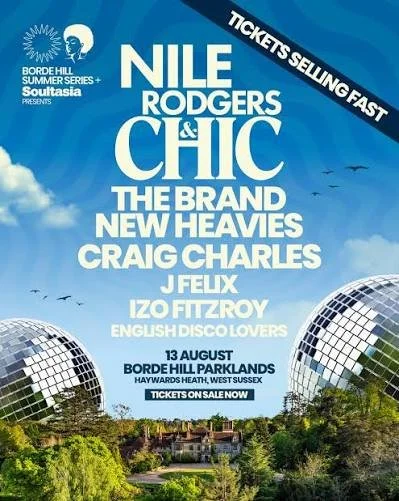
Nile Rodgers & Chic — Borde Hill Garden - 13th August 2026
Nile Rodgers & Chic — Borde Hill Garden
13 August 2026
Review by Robert Corich
There can’t be many musicians on the planet who can walk onto a stage and, without having written a single note of the opening song that evening, still have a legitimate claim to having shaped the bloody thing.
Nile Rodgers can.
And as “Le Freak” exploded across Borde Hill on Thursday night, the message was fairly clear:
This was not going to be a polite evening of nostalgia.
This was going to be a party.
Borde Hill is a ridiculous place to stage a concert — and I mean that in the nicest possible way. Vast gardens, open skies, trees disappearing into the distance and thousands of people initially sitting around with picnic blankets as if they’ve come for a particularly sophisticated outdoor lunch.
Then somebody announces that the blankets need to disappear and there’s going to be room for dancing.
And that’s when the evening really begins.
Because trying to sit down during a Nile Rodgers & Chic show is rather like trying to remain seated during an earthquake.
You can do it.
But why would you?
From the opening “Le Freak,” Rodgers and Chic embark on what is essentially a guided tour through the last fifty years of popular music — except the guide happens to have written, produced or played on a frankly ridiculous proportion of it.
CHIC provides the foundation.
“Everybody Dance.”
“Dance, Dance, Dance.”
“I Want Your Love.”
And suddenly Borde Hill isn’t a country estate anymore.
It’s Studio 54 with better trees.
Then the catalogue starts expanding.
Diana Ross.
Sister Sledge.
Madonna.
David Bowie.
Duran Duran.
Daft Punk.
Beyoncé.
It’s almost unfair.
Most musicians would kill for one career-defining song.
Nile Rodgers has spent decades casually accumulating them.
And the extraordinary thing is that they don’t sound like exhibits from a museum.
They sound alive.
The Chic material still has that wonderfully economical quality. Rodgers has never needed to throw twenty notes at a guitar when three will do the job. His playing is all about rhythm, space and that instantly recognisable clipped guitar sound.
You hear it and you know.
Before the vocal arrives.
Before the chorus.
Before the memory catches up.
You know.
And then there is the man himself.
Now, I’ve attended enough Chic gigs over the years to know that a Nile Rodgers performance normally comes with a second setlist — the one delivered verbally from the microphone.
The achievements are, admittedly, astonishing.
The hits.
The artists.
The records he wrote.
The records he produced.
The people he worked with.
The awards.
The stories.
And, to be fair, when you’ve had a career like Nile Rodgers, you’ve earned the right to tell a few of them.
But there comes a point, after you’ve heard the same catalogue of achievements explained for the umpteenth time, when even the most devoted fan can begin to feel that the evening has developed a slight case of self-gratification.
Yes, Nile.
We know.
You did Let’s Dance.
You did Like a Virgin.
You did Notorious.
You did CHIC.
You did Good Times.
You were there.
We were listening.
And that is why it was particularly refreshing that, on this occasion, there seemed to be a little less of the self-congratulatory autobiography.
The achievements were still there, of course — and quite rightly so — but they didn’t dominate the evening in quite the way they sometimes can.
Instead, the music was allowed to do rather more of the talking.
And frankly, that’s where Rodgers is at his most convincing.
Because he doesn’t actually need to tell us how important he is.
The songs do it for him.
There is no great wall between performer and crowd. Rodgers talks, smiles, gestures, encourages and, most importantly, looks as though he is still having an absolutely bloody brilliant time.
That matters.
Because this could very easily have been a heritage show.
Instead it feels like a celebration.
The difference is enormous.
The catalogue is staggering.
“I’m Coming Out.”
“Upside Down.”
“He’s the Greatest Dancer.”
“We Are Family.”
Then Madonna.
Then Bowie.
And when “Let’s Dance” arrives, the whole place erupts.
Of course it does.
Rodgers didn’t merely produce Let’s Dance. He helped turn it into one of those records that permanently altered the sound of mainstream pop. Hearing that guitar line out in the Sussex countryside, surrounded by thousands of people singing along, is one of those moments where you suddenly appreciate just how much music one man has put into the collective consciousness.
And there is something rather wonderful about watching the audience react.
People who probably arrived thinking they were here to hear Chic are suddenly singing Bowie.
People who came for Le Freak are dancing to Madonna.
People who grew up with Duran Duran are suddenly remembering that the guitar player on Notorious is standing right in front of them.
And then there is “Get Lucky.”
A song from a completely different generation, yet unmistakably Rodgers.
The fact that he can move from Chic’s 1970s disco to Daft Punk’s 2010s electronic pop without the evening ever feeling disjointed tells you everything about the man’s musical instinct.
The groove is the constant.
Everything else is decoration.
There is, inevitably, a more reflective moment.
“Thinking of You” is dedicated to Bernard Edwards, Rodgers’ great CHIC collaborator and friend.
Suddenly the party pauses.
Because beneath all the glitter, the dancing, the enormous catalogue of hits and the endless celebration, there is history here.
Real history.
Rodgers and Edwards weren’t simply successful musicians. Together they created a musical language that would be sampled, copied, reinterpreted and recycled for generations.
And Rodgers’ tribute to his old friend reminds you that behind every great song there are people, relationships and lives that can’t be reduced to a list of hit singles.
Then the groove returns.
Because it has to.
And eventually we’re heading towards “Good Times” — the song whose bassline and rhythm provided the foundation for Rapper’s Delight and, in a much wider sense, helped lay part of the groundwork for hip-hop.
Think about that for a moment.
A man standing on a stage in Sussex in 2026 is performing music that helped influence entire generations of musicians, producers and DJs.
And he still looks like he’s enjoying himself.
That’s the remarkable thing about Nile Rodgers.
For all the accolades, the Rock & Roll Hall of Fame, the Grammys, the production credits and the ridiculous list of people he has worked with, there is no sense on this particular evening of somebody merely turning up to collect the applause.
He plays.
He smiles.
He talks to the crowd.
And he gets people dancing.
Which brings us back to the beginning.
Because that’s what Nile Rodgers & Chic ultimately do.
They make people dance.
Not intellectually.
Not nostalgically.
Physically.
The kind of dancing where you stop worrying about whether you look ridiculous because everybody around you already looks exactly the same.
By the end of the night, Borde Hill is no longer a country estate.
It’s a giant dancefloor.
And Nile Rodgers is still standing there, Stratocaster strapped on, conducting the whole bloody thing.
There may not yet be an official setlist documenting every song played at Borde Hill — I lost my pen, sorry, although the surrounding dates show a remarkably consistent programme — but perhaps that’s appropriate.
Because this isn’t really about the order of the songs.
It’s about the sheer ridiculousness of the catalogue.
You could probably pick twenty songs at random from Rodgers’ career and still have one of the greatest greatest-hits albums ever made.
And on a warm August night in Sussex, he gave us the living, breathing version.
The grooves were immaculate.
The band were superb.
The songs were untouchable.
And Nile Rodgers?
Still getting lucky.
Still dancing.
Still making the rest of us move.
And, for once, letting the music do a little more of the boasting.
Not bad for a man who has been doing it for half a century.
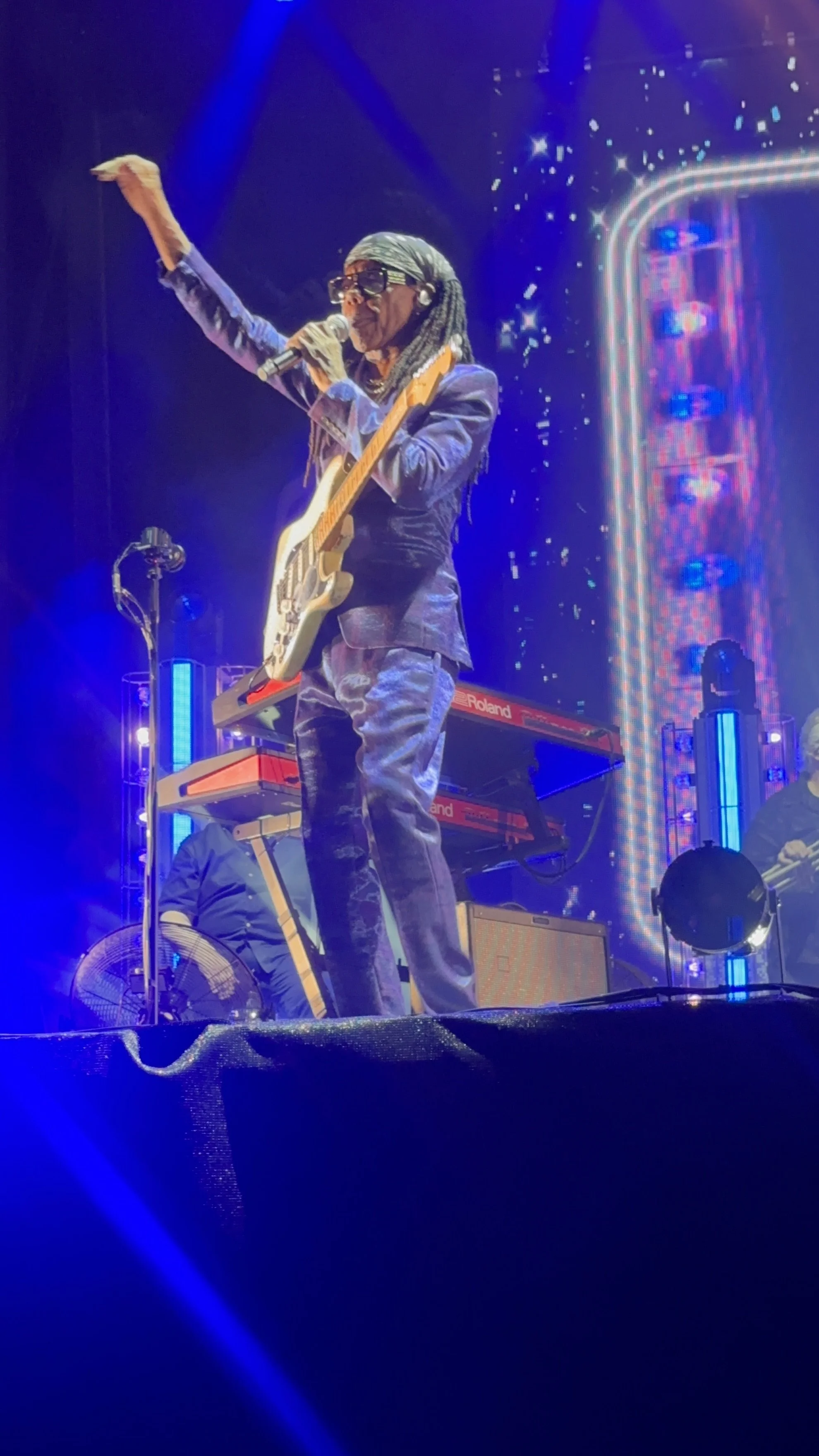
Photography by Michelle Fernandes