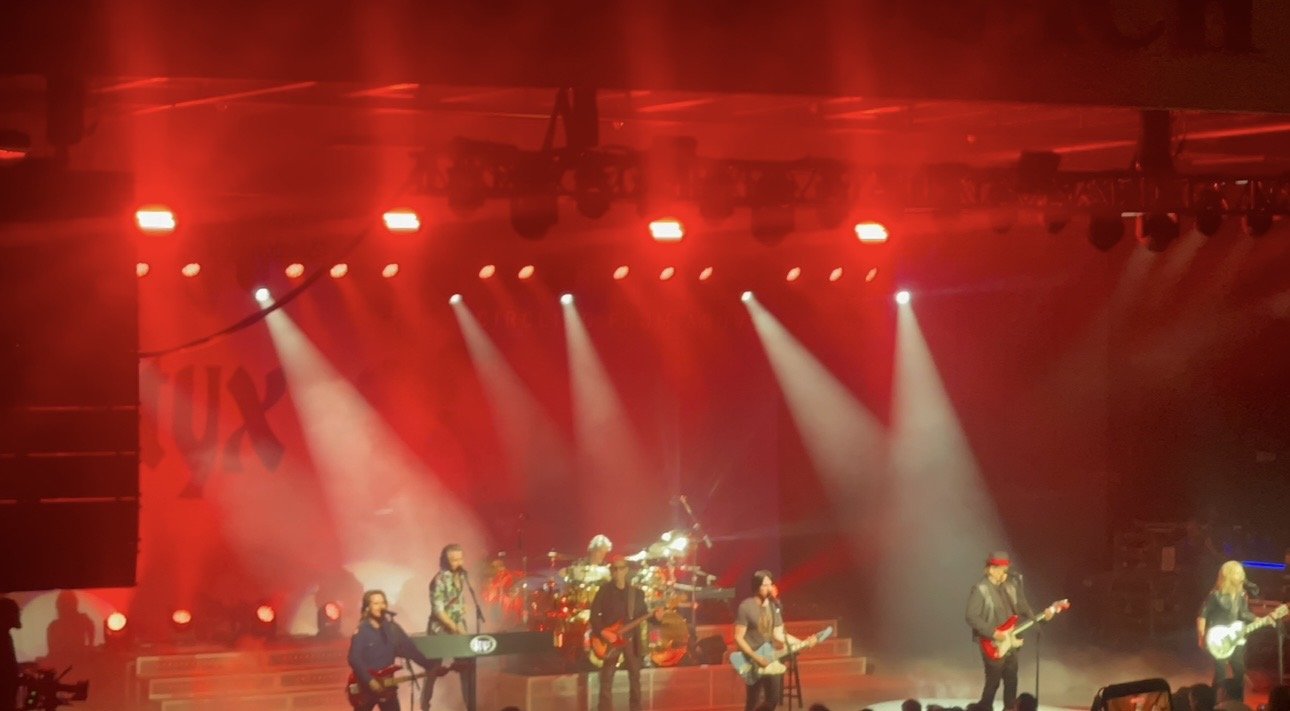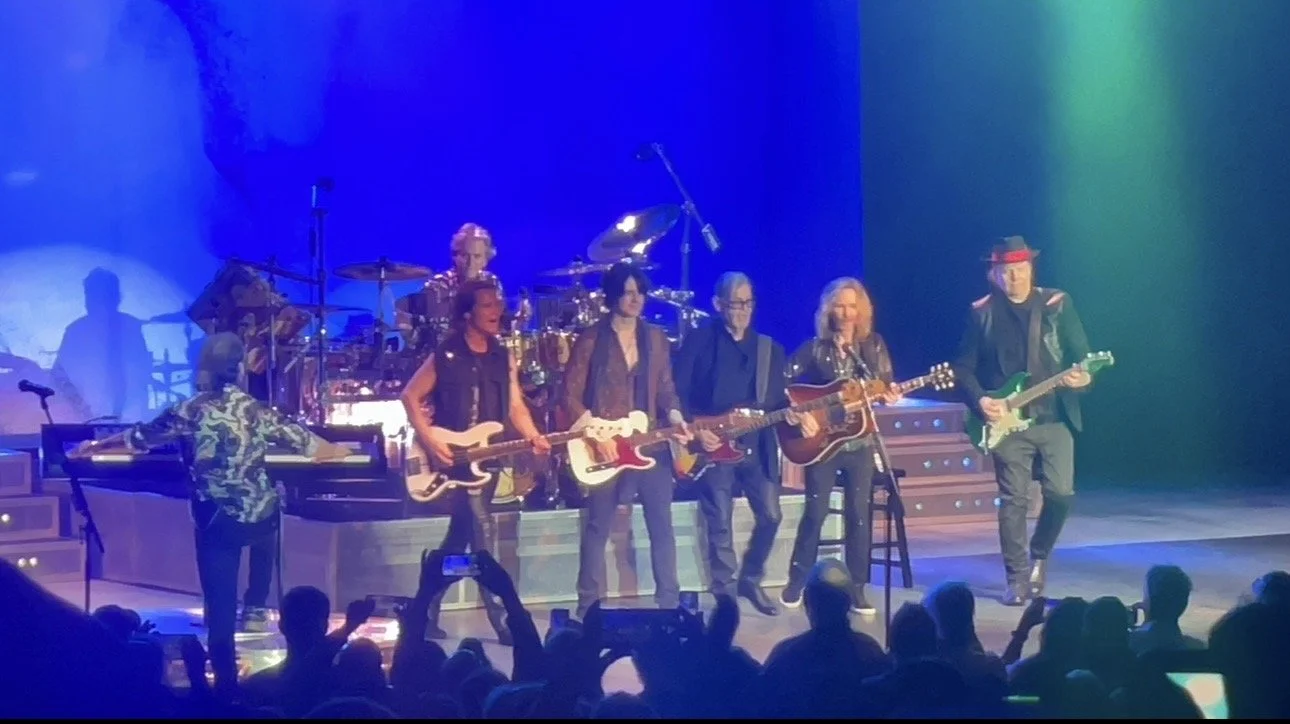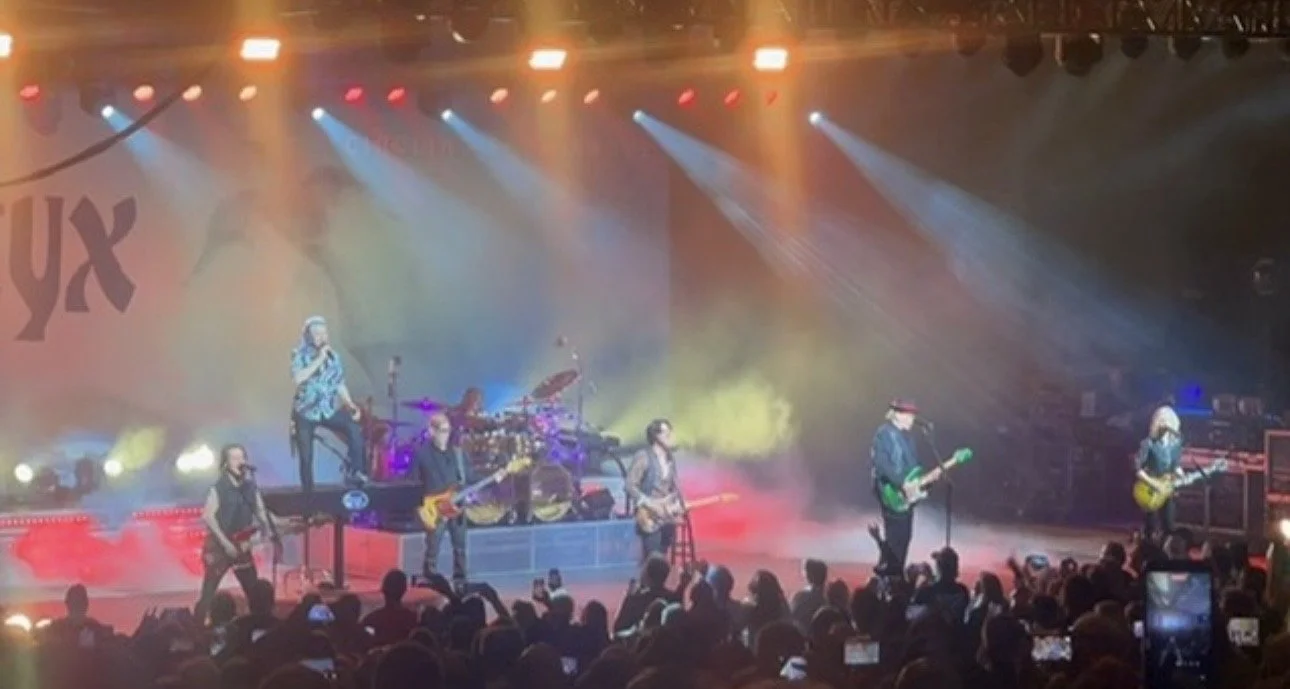
Styx — Live at Pompano Beach Amphitheater, February 22nd 2026
Styx — Live at Pompano Beach Amphitheater, February 22nd 2026
Review by Robert Corich
There are some bands whose music belongs so firmly to the soundtrack of your life that seeing them live is less a question of discovering something new than of finding out whether the songs you have carried around for decades still have the power to lift the roof off the place. Styx have never really had anything to prove in that department — but at Pompano Beach Amphitheater they certainly made a very convincing case for continuing to do so.
Before Styx took the stage, Jay Psaros had the unenviable task of warming up an audience waiting for a band with a catalogue as formidable as Styx. To his credit, he wasn’t bad at all. His set provided a relaxed and agreeable introduction to the evening, creating just the right musical entry point for the band that was to follow. No desperate attempt to steal the show, no awkward mismatch — simply a decent performance that got the evening moving in the right direction.
Then came Styx.
The evening opened with “Build and Destroy”, before moving into “Too Much Time on My Hands” and the wonderfully theatrical “The Grand Illusion”. It was immediately apparent that this was going to be a celebration of Styx’s considerable catalogue rather than simply a greatest-hits run-through. That distinction matters, because Styx have always been a band capable of balancing the concise radio single with the grander, more ambitious pieces that made albums such as The Grand Illusion and Pieces of Eight so enduring.
“Lady” brought the first real dose of nostalgia, while “Great White Hope” and “Light Up” reminded us that Styx could rock considerably harder than some of their more polished hits might suggest. “Lorelei” was another welcome trip into the catalogue, before “Crystal Ball” provided one of those moments where the musicianship and songwriting combine to make you wonder why certain songs ever became regarded as merely “deep cuts” in the first place.
The band introductions followed, and then came “Rockin’ the Paradise” — a title that could hardly have been more appropriate for a warm Florida evening. “Blue Collar Man (Long Nights)” was another high point, its muscular riff and relentless momentum proving that this is not simply nostalgia dressed up in stage clothes.
Then came “The Best of Times”, one of those Styx songs that manages to sound both gloriously uplifting and faintly melancholy at the same time. It was followed by “Fooling Yourself (The Angry Young Man)”, which remains remarkably relevant. Indeed, given the amount of angry young — and not so young — men wandering around the planet these days, perhaps Styx should consider making that one compulsory listening.
A piano solo provided the customary opportunity to take a breath before “Come Sail Away” arrived. And really, what can one say about “Come Sail Away”? It is one of those songs that begins as a piano-led ballad, gradually gathers momentum, and eventually becomes an arena-sized anthem that seems genetically engineered for several thousand people to sing along to. Pompano duly obliged.
The encore was, inevitably, going to require a little robotic assistance.
“Mr. Roboto” remains one of rock’s great examples of a song that could easily have become an embarrassing period piece but somehow hasn’t. Its electronic opening, theatrical delivery and wonderfully oddball subject matter still work — perhaps because Styx have never seemed embarrassed by their own eccentricity.
And then, naturally, “Renegade” brought proceedings to a suitably emphatic conclusion. Those opening notes are enough to send an entire audience into recognition mode, and by the time the song reached its familiar climax, Pompano Beach had become less an amphitheater and more a very large, very enthusiastic Styx choir.
There is, of course, no escaping the elephant — or should that be the Grand Illusion? — in the room. Styx’s extraordinary 1970s heyday, with Dennis DeYoung at the heart of the band’s distinctive vocal and theatrical identity, is unlikely ever to be bettered. That was a particular moment in rock history, and trying to recreate it would be both impossible and, frankly, rather pointless.
What is genuinely impressive, however, is that the modern incarnation of Styx is having one hell of a damn good go at it.
Rather than simply living off the glory years and endlessly touring the same collection of familiar songs, Styx have continued to create. In recent years they have produced brand-new albums of genuine substance, demonstrating that there is still songwriting ambition and musical purpose behind the name. That matters. It means this isn’t merely a heritage act polishing the chrome on yesterday’s hits; there remains a creative band underneath the considerable weight of its history.
And that perhaps explains why the live show works so well. The past is celebrated without pretending it can be recreated, while the present is allowed to have its own identity. The result is a Styx that may never surpass the extraordinary heights of the DeYoung era — but which has nevertheless managed to remain remarkably relevant, remarkably vital and, on this evidence, remarkably good fun.
What impressed most was the balance. Styx could have simply rolled out the familiar favourites and allowed nostalgia to do the heavy lifting. Instead, the set ventured sufficiently deeply into the catalogue to remind us that the hits were only part of the story. There was melody, bombast, musicianship, theatricality and, above all, a genuine sense that these songs were being performed because they still matter.
Styx may have been sailing through waters first charted several decades ago, but there was nothing particularly museum-like about this voyage. “The Grand Illusion,” “Crystal Ball,” “Blue Collar Man,” “Come Sail Away,” “Mr. Roboto” and “Renegade” remain remarkably seaworthy vessels.
And judging by the response in Pompano Beach, there are still plenty of passengers happy to climb aboard.